
A Tea Sets China buying guide Updated
Compare tea set quotations on the same configuration, quantity, currency and delivery scope. Then separate the unit price from additional order charges and calculate the average cost per complete set.
A low number beside “per set” is only useful when you know what the set contains and which costs the quotation includes. Keep exclusions and unconfirmed charges visible alongside the calculation.
Calculate each quotation separately, then keep its result with the comparison record below. Use complete sets as the quantity and one currency throughout.
Tea set quote cost calculator
Enter confirmed figures from one quotation, in one currency. Use complete sets as the quantity. The currency selection labels your entries; it does not convert them.
Blank means pending. Enter 0 only when a charge or discount is confirmed as none, or a charge is already included in the unit price. Do not add an included charge again.
Each money entry accepts 0–1,000,000.00, with up to two decimal places. A required charge that is still unconfirmed keeps the calculation pending.
Your entered-cost calculation
- Goods subtotal
- Extra order charges
- Order discount subtracted
- Total of entered costs
- Rounded average per complete set
The per-set result is an average of entered costs, not a new supplier unit price. It is rounded to two decimal places and may not multiply back to the exact total. A positive average that would round to zero is shown as <0.01.
This total contains only the figures you entered. Keep exclusions and unresolved terms visible alongside it. The calculator does not estimate taxes, duties or exchange rates.
Manual calculation: sets × unit price + separate shipping + one-time fees + other confirmed charges − separate order discount = entered total. Divide that total by the number of sets for the average per set.
Calculate one quotation, record its result and scope, then enter the next. Compare averages only after the included items and cost boundaries have been aligned.
1. Match the contents before comparing prices
Begin with a dated product reference and a complete contents list. Confirm the selected finish, vessel type, cup count and included accessories. A shared cup count does not identify the same configuration.
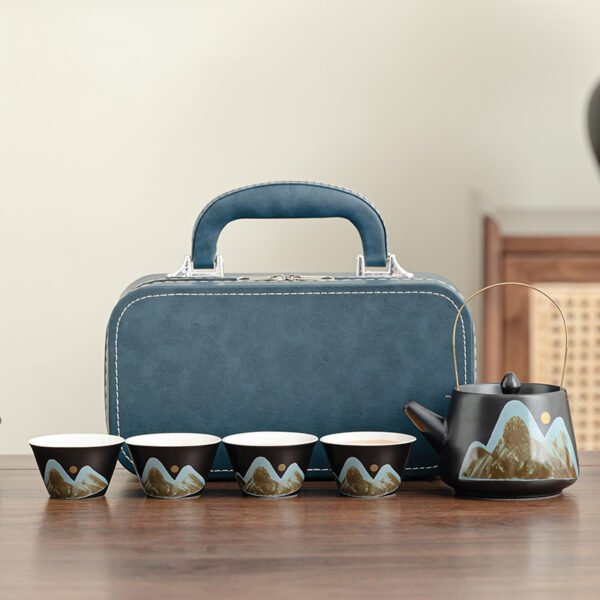
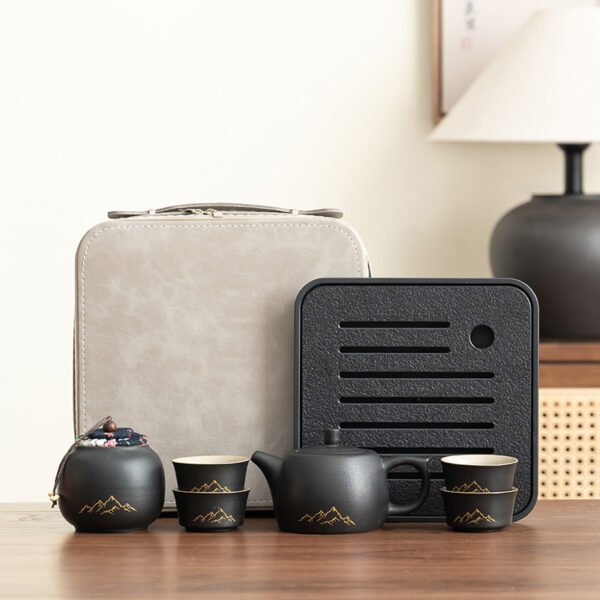
The blue-case mountain-landscape set supplies one lidded teapot, four cups and the case. The black mountain-motif set also supplies a tea jar and square tray. Their teapot capacities differ as well.
These are examples of different scopes, not two quotations for an identical product. Their photographs and specifications help demonstrate what needs to be aligned; no actual selling prices are compared here.
On a small screen, scroll the table sideways to read every column.
| Item | Mountain-landscape set | Black mountain-motif set |
|---|---|---|
| Lidded teapot | 1; approx. 230 ml | 1; approx. 200 ml |
| Tea cups | 4; approx. 40 ml each | 4; approx. 40 ml each |
| Tea jar | Not included | 1 included |
| Tea tray | Not included | 1 square tray included |
| Carrying case | Blue | Cream |
The tea set pieces guide helps identify the components. For a fair quotation comparison, specify the configuration you actually want instead of assuming that similarly named sets contain the same pieces.
2. Separate included costs from additional charges
Identify what the unit price already covers. If standard packaging or a decoration charge is already included, do not add it again as an extra fee.
Enter shipping, one-time fees and other confirmed charges as totals for the order. Examples to clarify include artwork or setup fees and any separately quoted packing charge. A fee described “per set” must be converted to the relevant order amount before entering it in an order-total field.
The discount field is an additional discount on the whole order. If the unit price already reflects the discount, enter zero unless another separate order discount has been confirmed.
Keep any unconfirmed required amount pending; the calculator’s input notes explain when zero is appropriate.
3. See how order charges change the average
Hypothetical example in one currency
Suppose a quotation lists 20 sets at 12.50 per set, 45.00 shipping and a 25.00 one-time fee, with no other charges included in this example and no separate order discount.
Goods subtotal: 20 × 12.50 = 250.00
Total of entered costs: 250.00 + 45.00 + 25.00 = 320.00
Average per complete set: 320.00 ÷ 20 = 16.00
These figures illustrate the calculation. They are not a Tea Sets China offer or a price for either pictured product.
For a second hypothetical quote in the same currency and with the same configuration, quantity, destination terms and exclusions, suppose the unit price is 13.00, shipping is 35.00 and the one-time fee remains 25.00. Its entered total is 20 × 13.00 + 35.00 + 25.00 = 320.00, also 16.00 per set. The lower unit price in the first example does not produce a lower entered average.
Both examples are arithmetic illustrations, not supplier offers. Record each quoted unit price separately from its calculated average.
For your own comparison, keep import duties, taxes, insurance, payment charges or other costs identified as included, separately confirmed or excluded. The calculator does not predict them. Its output is a total of entered costs, not a landed-cost guarantee.
4. Keep the scope and terms beside the result
Record the calculation with its underlying quotation. A lower entered average does not answer questions about different pieces, delivery responsibility or unconfirmed terms.
- Configuration: the product reference, finish, capacities, contents and any agreed customization.
- Quantity and unit: the number of complete sets and what the quoted unit price covers.
- Currency: the same currency for every entry and a clearly stated basis for any separate conversion you obtain.
- Charges and exclusions: included shipping or fees, additional order charges, the discount basis and unresolved costs.
- Delivery and payment terms: destination, delivery point, responsibilities and the conditions relevant to the quotation.
- Date and validity: the quotation revision, validity period, timing assumptions and anything still awaiting confirmation.
Keep an A / B comparison record
Use one record per quotation. Compare these fields together, rather than saving only the calculator’s average:
Quote reference and date: A [___] / B [___]
Configuration and complete-set quantity: A [___] / B [___]
Currency and quoted unit price: A [___] / B [___]
Included costs / separate order charges: A [___] / B [___]
Entered total / average per set: A [___] / B [___]
Destination and delivery responsibility: A [___] / B [___]
Exclusions and unresolved costs: A [___] / B [___]
Payment, timing and validity: A [___] / B [___]
For a branded gift project, the corporate tea gift guide covers the wider brief. If a sample is used to confirm the configuration, keep its accepted details with the quotation using the sample review checklist.
Common quotation-comparison questions
Should I enter a cup count as the quantity?
No. This worksheet uses complete sets. If a supplier quotes individual pieces, clarify or normalize the unit before comparing it with a set price.
Can I compare totals in different currencies?
Not directly. Use a common currency with an explicitly recorded conversion basis. The currency selector labels the calculation; it does not convert an amount when changed.
What if a required charge has not been confirmed?
Keep it unresolved and request clarification. Do not enter zero simply to obtain a result. Costs outside the quotation’s scope should also remain visible as exclusions alongside any entered total.
Request a quotation with a clear comparison scope
Send the product link, number of sets and delivery destination. Identify any branding or packaging requirements and the charges or exclusions you want clarified.
Sources and method: linked product listings and photographs, reviewed on 28 October 2026. Both quote examples are hypothetical and are not offers for the pictured products. The calculator adds entered figures; it does not obtain prices or estimate taxes, duties or exchange rates.