
A Tea Sets China buying guide Updated
For a custom tea set logo, identify the exact components, supply one clearly named artwork version and mark the proposed position, orientation and physical size. Then review the proof against that brief before confirming its scope.
A request such as “add our logo” leaves important details open. A logo on one cup, every cup or the carrying case represents a different decoration scope, even when the underlying tea set is the same.
Keep three records together
- The selected product and decoration brief.
- The artwork file and its revision.
- The proof reference, review decision and open questions.
Download the one-page artwork brief
Use the fillable PDF in a PDF reader, or print it. Record the product, components and decoration quantity per set, exact wording, artwork revision, proposed size and proof-review notes.
Download artwork brief · PDF, 1 pageSave the completed record and share it through your agreed enquiry channel. Keep any unconfirmed requirements in its open-questions field.
1. Specify which pieces receive the decoration
Start with the product link, finish, quantity of complete sets and destination. Then list the components proposed for decoration: for example, the teapot, one cup, all four cups or the case.
Keep the quantity of sets separate from the number of decorated pieces within each set. State whether the same artwork appears on every selected component or whether different wording or placement is requested.
The current custom tea set service assesses artwork and branding requests for the selected product. A standard set’s contents do not mean that every included surface can receive the same decoration.
Artwork file
The logo or wording itself, identified by a clear filename and revision.
Placement reference
The particular component, proposed location, direction and requested physical size.
Proof record
The version reviewed, what was confirmed and what still needs clarification.
2. Send a clearly identified artwork version
Keep the original artwork file separate from any product photograph used to explain placement. Identify the current file as the version to assess, and label earlier files as superseded if you include them.
- Exact wording: check spelling, letter case, punctuation and any line breaks.
- Artwork revision: use a filename or revision reference that can also appear in the proof record.
- Visual reference: identify the intended colours and any existing brand reference you want assessed.
- File requirements: ask which formats and detail requirements apply to the proposed decoration method and component.
Keep the editable source and any supplied viewing reference together. Agree the required file format and detail limits for the selected method; this guide does not set a universal resolution or lettering size.
3. Mark the position, orientation and size
On a reference view, identify the component and proposed location. State which way the logo should face relative to a recognizable feature, such as the spout, handle, case front or zipper.
Give the requested artwork width and height with units. Distinguish the logo dimensions from the overall vessel or case dimensions. Ask for the feasible decoration area and any relevant limitations to be confirmed.
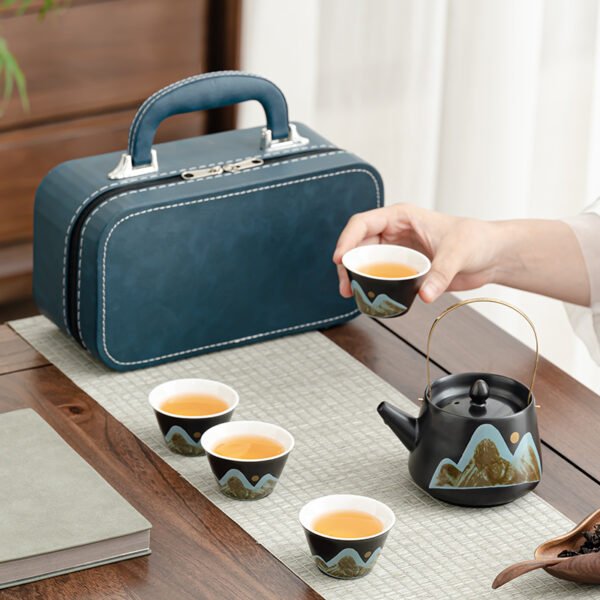
For the pictured set, the existing mountain motif, curved teaware, case stitching and hardware are visible context. Discuss how the new artwork relates to those features rather than assuming the whole visible surface is available.
The example below shows a request with separate position, size and revision records.
A placement reference with a usable revision record
Example brief to accompany the reference
- Component and count: case front only; one decorated case per complete set; no decoration requested on the teaware.
- Artwork: YOUR LOGO, file reference “example-logo”, revision B.
- Position and direction: proposed centred position on the identified front panel; top of the artwork toward the marked orientation reference.
- Requested size: 40 mm wide × 15 mm high; artwork dimensions, not panel dimensions.
- Open questions: feasible area, exact position, method, colour requirements, file format, fees and timing.
- Review record: example proof B1; wording checked; placement feasibility and production details pending.
These entries show how to describe a request. They are not an accepted project or a production instruction. In a real brief, use the selected product view and agree the position references rather than relying on “centred” alone.
4. Agree what the proof or sample will demonstrate
Ask what review steps are available for the selected project. A digital visual proof can communicate a proposed arrangement; a physical sample, if arranged, addresses a different stage of the review.
Identify the product configuration and artwork revision on the proof. Request clear placement and dimension notes, plus the proposed method and colour information where relevant. Clarify anything the image does not represent.
An on-screen image does not establish the finished surface, exact colour appearance or durability. If a particular appearance or physical detail is important, agree how it will be assessed rather than treating the digital view as a test result.
For sample review, keep the artwork details with the wider configuration record. The tea set sample checklist explains how to document observations and unresolved changes.
5. Review one proof version against the brief
- Component and count: the correct pieces and number of decorated pieces per set.
- Wording and artwork: exact spelling, letter case, line breaks and the intended file revision.
- Placement and direction: the agreed side, orientation and relationship to existing decoration.
- Physical size: width, height, units and the measurement reference.
- Method and appearance: the proposed process, colour references and any aspects still awaiting confirmation.
- Review record: proof reference, revision, date, requested changes and the scope actually confirmed.
Keep the decision specific. “Text and placement confirmed; colour appearance still to be reviewed” records more than a general “looks fine.” Save the reply with the exact proof file it concerns.
6. Keep revisions connected to the quotation
If wording, size, placement or the selected components change, request an updated reference and identify which earlier version it replaces. Ask whether the change affects feasibility, fees, quantities or timing before proceeding.
Keep artwork review separate from the other order conditions that need confirmation. The quotation comparison guide helps distinguish included decoration costs from additional order charges and exclusions.
For a larger gift project, the corporate tea gift guide covers recipient configuration and presentation requirements. This artwork brief supplies the more detailed record for the selected decoration.
Can the same logo be placed on the case and all cups?
List each proposed application and its count. Feasible areas, methods and costs need to be assessed for those specific components rather than assumed from one example.
Can I revise the artwork after reviewing a proof?
Send the change with a new revision reference and ask what needs to be reviewed again. Confirm any impact on the proposed order; the earlier proof does not describe artwork that has since changed.
Start with a product reference and a clear artwork brief
Send the selected set, quantity, destination, artwork version and proposed placement. Use the worksheet to keep the details and review notes together.
Sources and scope: linked service and product information, reviewed on 28 October 2026. The three photographs show standard designs, not customer-logo projects. The diagram and filled brief are hypothetical teaching examples. Feasible areas, methods, file requirements, samples, quantities, costs and timing are assessed for the actual request.