A Tea Sets China teaware guide Updated
A tea caddy specification can describe three different things: the jar’s volume, the weight of tea it holds or the weight of the jar itself. Read the label beside the number before comparing sizes.
Millilitres (ml) describe volume. Grams (g) describe mass, but a gram figure needs a subject: tea, the empty container or the complete packed item. Those entries cannot be compared as though they all mean storage capacity.
Three real examples, three meanings
- 200 ml: a listed tea-jar volume.
- About 90 g of Tieguanyin: a tea-storage reference.
- About 50 g: a particular jar’s own weight.
1. Separate volume, tea weight and container weight
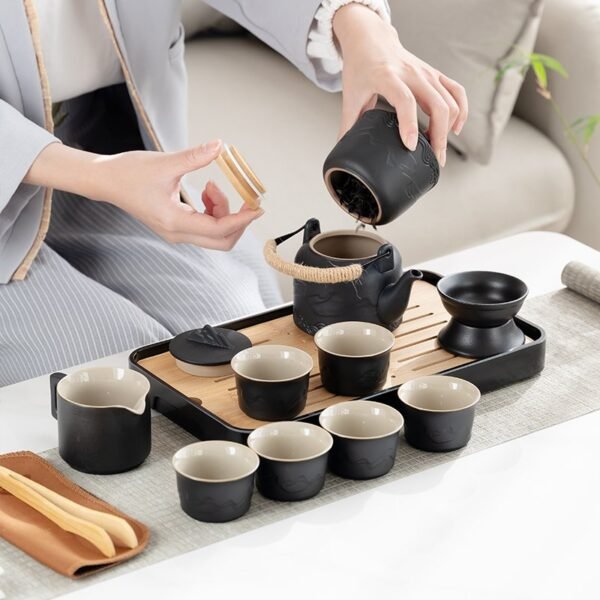
Here, “tea caddy” means the covered tea-storage jar supplied with a set. Its specifications belong to that jar, separately from the teapot, serving pitcher and cups. The tea set pieces guide explains those different roles.
Jar volume · ml
A volume entry describes the jar’s listed capacity. Ask how it was measured and what fill level the figure represents.
Tea weight · g
A storage reference concerns a stated tea and filling condition. It does not establish the same weight for every kind of leaf.
Jar weight · g
A container-weight entry concerns the jar itself. Confirm whether the quoted figure includes its lid, cover or other parts.
A 200 ml jar is not a 200 g tea specification. To connect volume with the mass of dry tea, you need information about that tea and how it occupies the space. The volume number alone is insufficient.
2. Read the complete entry in a product listing
These examples show why the wording matters as much as the unit. Each figure comes from a different set; the table is not a ranking of which jar holds the most tea.
On a small screen, scroll the table sideways to read every column.
| Set example | Listed figure | Meaning | Question to confirm |
|---|---|---|---|
| Mountain-relief set | 200 ml | Tea-jar volume | What measurement and fill level does the capacity describe? |
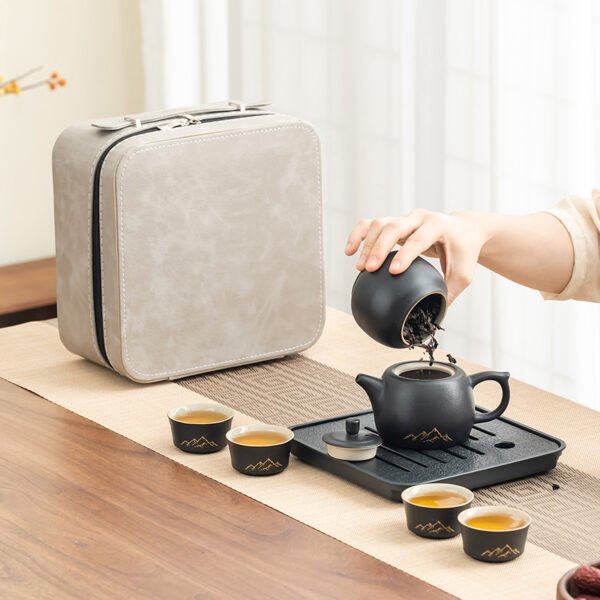
| Black mountain-motif set | Approx. 90 g | Tieguanyin tea-storage reference | What tea form and filling condition support the reference? |
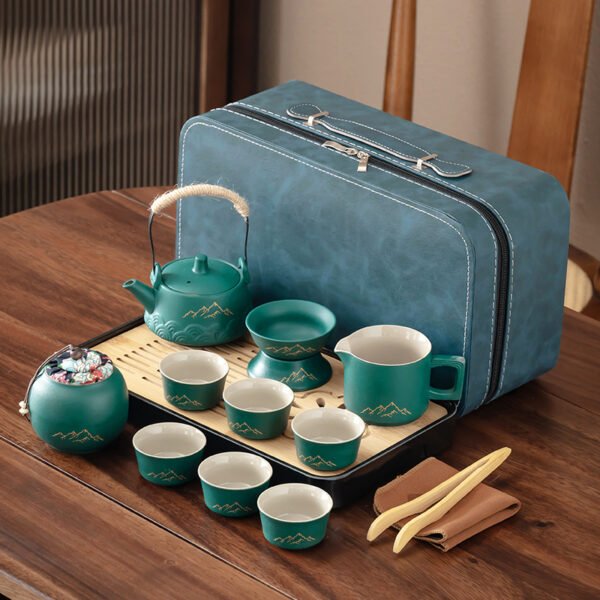
| Green six-cup set | Approx. 50 g | The jar’s own weight | Which lid or cover parts are included in that weight? |
Compare like with like: shared volume measurements, the same tea under the same filling conditions, or the same empty-container assembly. These three different entries cannot rank the jars by tea storage.
3. Keep the tea type with a gram reference
Dry leaves occupy space differently according to their shape and packing. A reference tied to one tea does not establish the amount of a different tea that will fit in the same jar.
Keep the tea identity, leaf form, filling method and fill level with a weight reference. Rolled leaves and differently shaped loose leaves need not occupy the same space at the same weight. Use a repeatable weighing record for your own tea.
4. Record the amount of your own tea
If you already have the jar, a before-and-after weighing can record the tea you put into it. Use a scale suitable for the amount being measured and keep the container configuration consistent.
- Weigh the clean, dry empty jar with the lid or cover arrangement you will use for both readings.
- Add your identified dry tea to the chosen fill level.
- Weigh it again with exactly the same lid or cover parts.
- Subtract the empty-container reading from the filled-container reading.
Illustrative arithmetic, not a product specification
Suppose the empty container and cover weigh 80 g and the same assembly with tea weighs 110 g.
110 g − 80 g = 30 g of tea
These hypothetical readings demonstrate the calculation. The result records that fill of that tea; it is not a tested capacity for any jar pictured here.
Use your own empty reading for the same assembly, rather than subtracting a catalogue weight with an unknown lid basis. Save a fill-level photograph with this record:
Weighing record: jar reference ___ · tea and leaf form ___ · fill level ___ · lid/cover parts included ___ · empty ___ g · filled ___ g · tea by subtraction ___ g · date ___.
5. Check dimensions and the cover separately
The green set’s jar has a listed size of 8.5 × 8.7 cm, given as length × height. That entry and its approximate 50 g weight describe different properties. Neither supplies a confirmed tea-storage quantity.
A listing’s length and height do not establish its internal volume. Confirm the measurement points, opening and usable interior rather than calculating capacity from a photograph or an assumed cylinder shape.
A lid or patterned cover also does not, by appearance alone, establish an airtight seal. If sealing or longer-term storage matters to your purchase, ask about the closure construction and relevant product information. A volume or weight entry is not a freshness guarantee.
For carrying requirements, ask for the weight of the complete packed set separately. One jar’s weight is not the weight of its teaware, case and packaging; see the travel tea set packing guide for the full arrangement.
Questions to include in your enquiry
- Exact jar: the product link, configuration and preferred finish.
- Number and subject: whether the quoted figure means volume, tea weight, jar weight or packed weight.
- Measurement basis: the fill level, included lid or cover parts and any approximate measurement conditions.
- Your tea: its identity, leaf form and the amount you want to store.
- Physical fit: the opening, relevant dimensions and its place in the carrying case.
- Closure and care: the actual construction and component-specific instructions you need.
For a bulk-order sample, carry these clarified entries into the same dated specification as the other components. The sample review checklist explains how to record confirmed details and unresolved questions.
Ask for the quantity you actually need
Send the product link and tell us whether you need a volume figure, a tea-storage reference, a container weight or a packed-set weight. Include the tea and filling requirement where relevant.
Sources and method: linked listings and photographs, reviewed on 28 October 2026. Product entries retain their stated measurement subjects. The 80 g/110 g arithmetic is hypothetical; no capacity, sealing or tea-weighing test was performed for this guide.