
A Tea Sets China teaware guide Updated
Choose a gongfu tea tray around the pieces you want to place on it, the space needed to handle them and the surface’s intended use. A listed length and width are only the starting point.
Some arrangements keep the brewer on the tray and cups beside it. Others give a pitcher and strainer their own positions. Decide which layout you want before comparing tray sizes.
Four questions to start with
- Which vessels need a place on the tray?
- How much usable top space is available?
- How is liquid handled and the tray cleaned?
- Where will the tray be stored after use?
1. Start with the pieces you will handle
A tea tray gives selected brewing and serving pieces a defined place on the table. It does not have to contain the entire tea service. Make a list of the items you want on the tray and those you will place in the surrounding serving area.
For a teapot-and-pitcher layout, account for the teapot, receiving pitcher, any strainer and its stand. For a removable-infuser layout, account for the outer vessel, the lifted insert and somewhere to place the lid. Our tea set pieces guide helps identify the components.
Make a dry layout with your actual vessels before selecting the tray. Keep cups beside the tray if that is how you plan to serve; cup count is not a formula for tray fit.
Try a paper layout before comparing dimensions
- Mark the proposed usable top outline on paper using confirmed measurements.
- Place the clean, dry brewer and receiving vessel in their proposed positions. Include projecting handles and spouts.
- Give the lid, lifted insert or strainer a resting position. Practise reaching and replacing each piece without hot liquid.
- Record the occupied outline and the separate table area for cups and accessories.
This checks your planned arrangement. A listed outside tray size cannot be substituted for a usable-top measurement.
Listed size
The length, width and height given for the product. Confirm the measurement points.
Usable top
The space where vessel bases can sit, taking the rim, openings and surface shape into account.
Table area
The tray plus the space you choose for cups, other accessories and handling the pieces.
2. Read length, width and height separately
Keep the measurement order with the figures. A long, narrow tray and a square tray provide different arrangements even when neither is especially large. An oval outline also gives you a different edge shape from a rectangle.
The examples below use current listing dimensions. They do not supply internal usable dimensions; ask whether the stated length and width describe the outside outline or another measurement reference.
On a small screen, scroll the table sideways to read every column.
| Set example | Tray shape | Listed L × W × H | Cups in set |
|---|---|---|---|
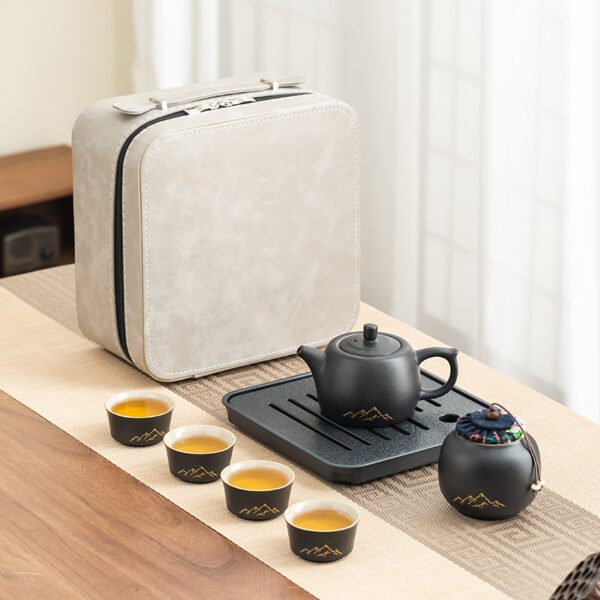
| Black mountain-motif set | Square | Approx. 19.5 × 19.5 × 2.2 cm | 4 |
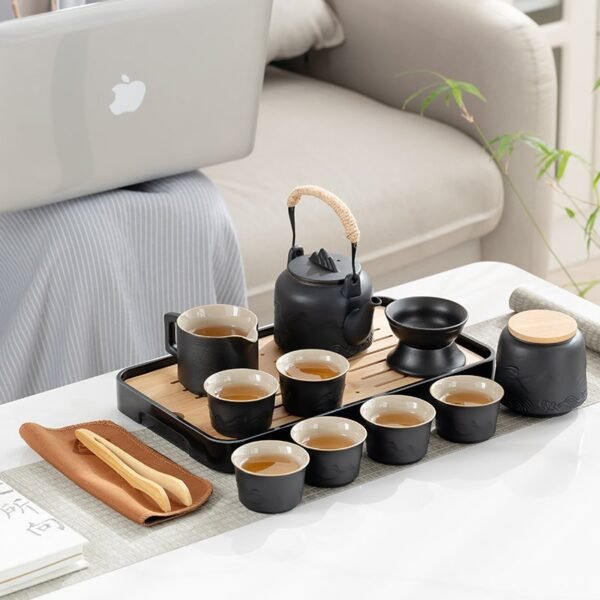
| Mountain-relief set | Rectangular | 31.5 × 18 × 3.7 cm | 6 |
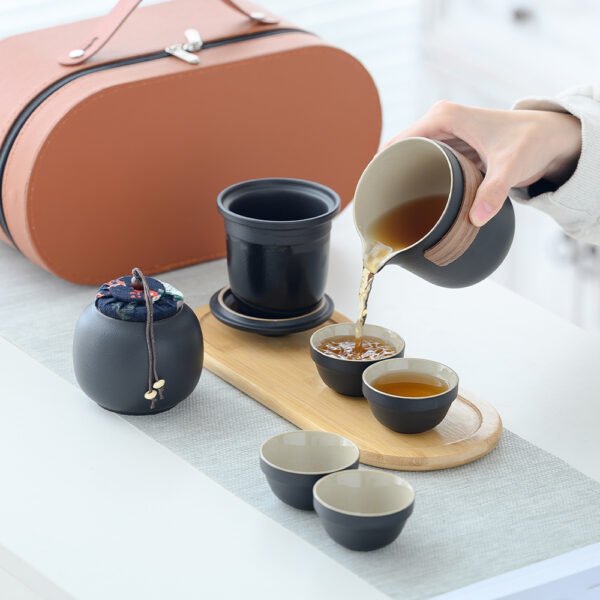
| Black infuser set | Oval | 27.5 × 10.5 × 3.4 cm | 4 |
Cup counts identify the supplied configurations. They are not claims that all cups and vessels fit on the tray simultaneously. Listed tray height is not a liquid-capacity specification.
3. Look beyond a slotted or solid surface
The square and rectangular examples have visible slots; the oval example has a solid surface. To understand liquid handling, look for a view of the base and, where removable, the underside of the top.
For a slotted design, ask what is beneath the top: is there a collection base, an outlet or another arrangement? Confirm whether the top lifts off, how any collected liquid is emptied and which parts can be cleaned separately.
For a solid surface, identify the spill-emptying and cleaning method. Record the tray material separately from the vessels’ material.
Use a tray for discarded rinse water only when that use is specified. The photographs and outside dimensions here do not establish a reservoir, liquid capacity or leakproof performance.
4. Leave room for the serving sequence
Think through the movements rather than just the final display. Where does the lid go when you add leaves? Where will an insert or strainer rest? Can you lift the pitcher without moving another vessel first?
The rectangular example places the teapot, pitcher and strainer arrangement on the tray, while several cups and the jar sit outside it. That division of space is useful to notice when planning your own table.
A fairness pitcher adds a receiving-and-serving stage. A removable infuser or separate strainer also needs an intended resting position. Include those handling steps when assessing the layout.
5. Check cleaning access and storage before ordering
Choose a tray whose parts and care requirements you can identify. A product’s vessel material does not automatically describe the tray, its surface insert, feet or base.
- Material: confirm the tray and any separate top or base components.
- Cleaning access: identify removable parts and the specified cleaning and drying method.
- Liquid handling: confirm the intended use, emptying method and any relevant capacity information.
- Working space: request usable top measurements as well as clearly labelled listing dimensions.
- Storage fit: check its designated case position or the space where you will keep it.
- Configuration: confirm the tray supplied with the selected set and any proposed replacement.
In the mountain-relief and square mountain-motif sets, the case photographs show the tray stored inside the lid. Use the arrangement specified for that model. Our travel tea set packing guide explains how to check the inventory, layout reference and final open-case view.
Common questions about choosing a tea tray
Does every cup need to sit on the tray?
That depends on the layout you want. The examples here place some or all cups beside the tray. If you want the complete service on one tray, request usable dimensions and compare them with the actual vessels and handling space.
Does a larger tray automatically suit more people?
Not by itself. The number and shape of the vessels, their placement and the surrounding table area all matter. Cup count is a set configuration detail, not a tray-capacity rating.
Can I buy a matching tray separately?
The pictured trays are included in their respective tea sets. Ask whether a separate tray or compatible replacement is available for the selected model; do not assume the shapes or case fit are interchangeable.
Match the tray to the way you want to serve
Send the product link, the pieces you want to place on the tray and any table or storage limits. Ask about usable dimensions, construction and care for that configuration.
Sources and scope: linked product photographs and listing dimensions, reviewed on 28 October 2026. Usable-top dimensions and base construction are not established for these examples; no drainage or layout measurements were performed for this guide. Obtain those details for the selected tray.