
A Tea Sets China teaware guide Updated
Before closing a travel tea set, check that every included piece has a documented place. Match the complete contents to the case’s compartments or nesting layout, then check the last open-case view and the normal closure.
The photographs below show two storage patterns: fitted compartments and matched nesting pieces. Use them to identify the reference views you need for your exact model; neither is a complete start-to-finish packing demonstration.
Three records make a layout usable
- A complete inventory with the cup and accessory counts.
- A storage view linking those pieces to their positions.
- A final open-case view showing everything before closure.
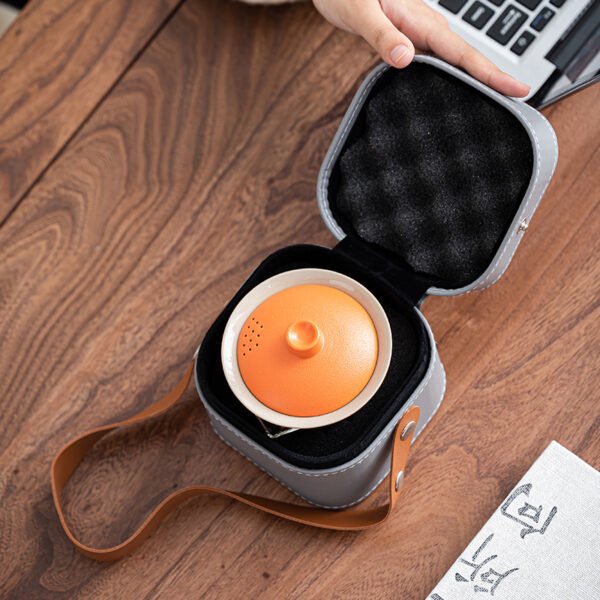
1. Start with a complete inventory
For storage after use, follow the component-care instructions and lay the clean, cool, dry pieces beside the open case. Count the whole set before trying to match it to a photograph.
Count the cups and identify the smaller pieces before putting anything away. If the set has a separate strainer, stand or removable insert, count those individually. Our tea set pieces guide can help identify the different parts.
When unpacking a new set, photograph the original arrangement before removing pieces, then take an inventory view with all parts visible. Keep both views with the product reference and packing instructions.
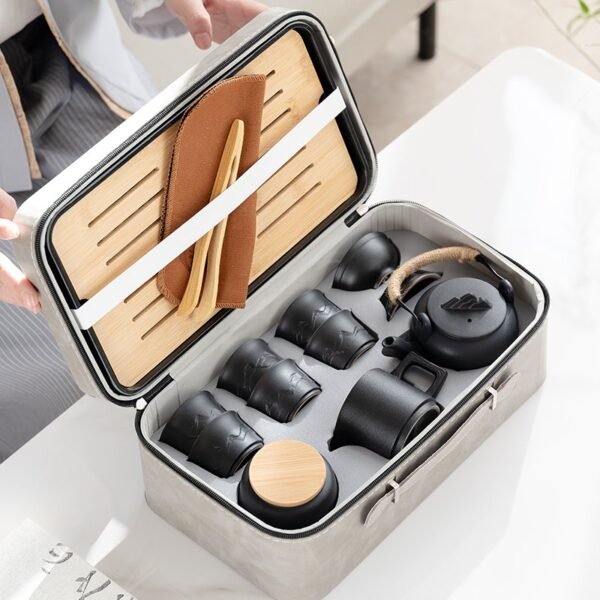
2. Read a fitted-compartment layout
In a compartmented case, identify the intended space for each vessel before placing it inside. Check the complete outline, including the spout, handle and lid knob. A round opening alone does not establish which part belongs there.
The mountain-relief example shows spaces for the teapot, pitcher, strainer and tea jar, with the tray and accessories held inside the lid. A complete reference for this six-cup set must also account for all six cups—the photo does not make each one visible.
Position the handles as specified for the set. Do not assume an overhead handle folds or detaches; our teapot handle guide explains the movement and measurement details to confirm.
If a part will not seat normally, stop and compare it with the reference. Check whether a lid, accessory or different component is occupying its space rather than using the case closure to press everything down.
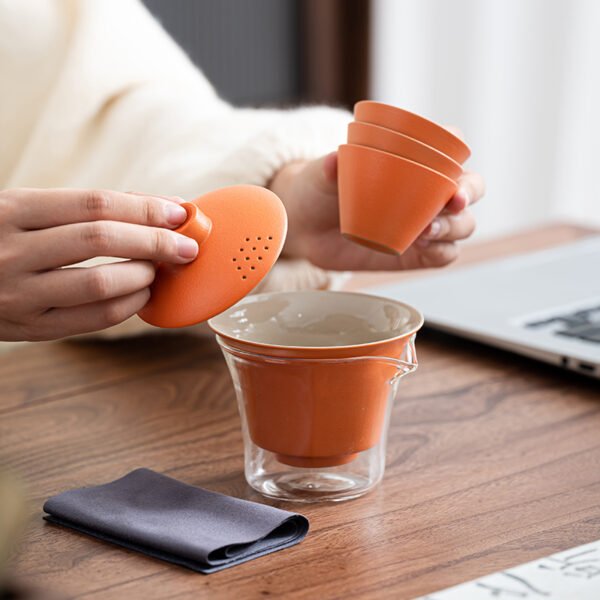
3. Check what a nesting photograph actually shows
The orange stackable example shows two relationships: three cups stack together, and the brewing bowl nests inside the clear serving pitcher. These shapes belong to a matched set.
To turn this component view into usable packing instructions, obtain a view of the final cup stack position, the lid position and the complete open case. Follow the sequence supplied for that exact set; the photograph alone does not fill in those missing steps.
A replacement must match both the nested pieces and their case space. The replacement-part measurement guide explains why equal cup capacity does not establish a matching rim, base or height.
4. Check the pieces that are easy to overlook
Work through the actual contents list. The checks below apply where those parts are supplied; they are not a universal list of accessories included with every travel set.
On a small screen, scroll the table sideways to read all three columns.
| Component | Check its position | If it does not fit |
|---|---|---|
| Cups | Count the full set, then use the specified stack or individual positions. | Check for a missing cup, a different cup or an incorrect stacking order. |
| Lid, spout and handle | Match the vessel’s orientation and leave its projecting parts in their intended spaces. | Recheck the layout; do not force a handle to fold or the lid to press down. |
| Insert, strainer and stand | Identify each part and its specified storage relationship. | Confirm which component belongs with the brewer or pitcher. |
| Tray and accessories | Use their designated compartment or retaining arrangement, if supplied. | Compare the lid area and the accessory list with the packing reference. |
| Cloth and case interior | Check that both are dry and that the cloth is in its intended position. | Follow the relevant care instructions before packing away. |
A removable brewing insert and a separate pour-through strainer are different components. The infuser and strainer photo guide helps identify the arrangement before you decide what belongs together.
5. Review the last open-case view before closing
- Complete count: all cups, lids and included accessories are accounted for.
- Correct layout: each piece is seated in its own intended compartment or matched nesting arrangement.
- Clear closing path: nothing lies across the case rim, closure or an area where it will be pressed by the lid.
- Small parts secured: supplied straps, holders and separators are restored as intended.
- Normal closure: the lid and fastener close without forcing the contents into place.
- Case ready: check the closure, strap and attachment points before lifting.
Compare the final open case with the final reference view. Use the inventory and labelled intermediate photographs or a layout diagram to account for pieces hidden by stacking or nesting. If the closure needs pressure, reopen it and resolve the layout rather than using the lid to compress the contents.
A carrying case is one part of the packing arrangement
These photos show how tea pieces are stored together. They do not establish drop protection, waterproofing or suitability for checked luggage. For a parcel shipment, confirm protective materials and the outer carton separately from the carrying case.
Common packing questions
Can I add an extra cup or a larger pitcher?
Confirm the revised layout first. Spare space in a photograph is not proof that another part fits, and a larger vessel may not match the original insert or nesting pieces.
Can I use the included tea cloth as padding?
Use it in the position specified for the set. Adding material between fitted or nested pieces can change their fit; do not assume the cloth is intended as a separator for every component.
What should I ask before buying a set for a small bag?
Ask for the packed case’s external length, width and height, and its packed weight if that matters to you. A vessel’s dimensions are not the case dimensions. The travel tea set buying guide covers the wider selection questions.
Choose a set with a layout you can understand
Explore the current sets, then send the product link and ask about its packing sequence, included parts or packed dimensions.
Sources and scope: linked listings and existing photographs, reviewed on 28 October 2026. This is a guide to checking packing references for an empty set, not a complete model-specific assembly sequence or a transport test. Use the selected model’s complete instructions for the actual arrangement.