
A Tea Sets China teaware guide Updated
An overhead teapot handle arches above the lid. A rear handle projects behind the body, opposite the spout. That difference changes where you reach to hold the pot—and what you need to check around the lid and carrying case.
Use the photographs to shortlist a layout, then compare three practical details: access to the lid, space inside the grip and the pot’s stored outline. This is a visual selection guide; use and care follow the instructions for the exact pot.
Look at three things before choosing
- Where the handle sits relative to the spout and lid.
- How the lid opens and the pot fits its case.
- Which vessels and cups come with that particular set.
Identify the handle by its position
Find the spout first, then locate the grip. In this guide, overhead means the arch above the pot and rear loop means the loop opposite the spout. These are descriptions of the pictured layouts, not a complete classification of every teapot.
Overhead handle
The grip is above the body. Look at the space between the arch, lid knob and opening, and ask how the handle is positioned when filling or packing.
Rear-loop handle
The grip sits behind the body, opposite the spout. Look at the loop opening, its relationship to the lid and the overall spout-to-handle length.
“Side handle” can be an ambiguous label: it may also refer to a handle that projects sideways relative to the spout. Ask for a clear view of the actual pot rather than relying on the name alone.
Overhead handles: check the lid and storage position
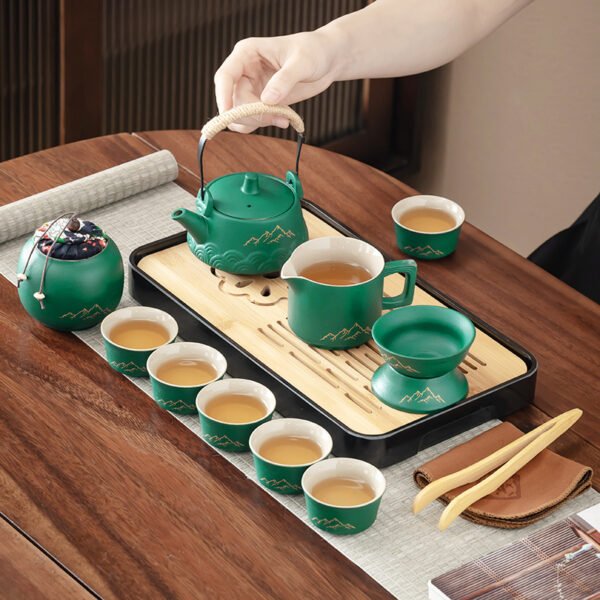
In the green example, the arch passes above the lid knob. Compare that gap with the route needed to lift the lid: a useful reference view shows the lid in place and lifted, with the handle in its intended position.
Record whether the handle is fixed, pivots or is removable, then save the corresponding packed view. Movement is not established by this photograph, so do not plan a folded storage position without that model’s instructions.
Ask what the quoted height includes
Ask for two clearly labelled records where relevant: overall height in use and height in the intended packed position. Keep the handle position with each figure; a body-and-lid height answers a different question.
An arch can resemble the handle of a kettle. That resemblance does not establish stovetop suitability: check the instructions for the exact product before applying heat.
Rear-loop handles: check the grip and overall length
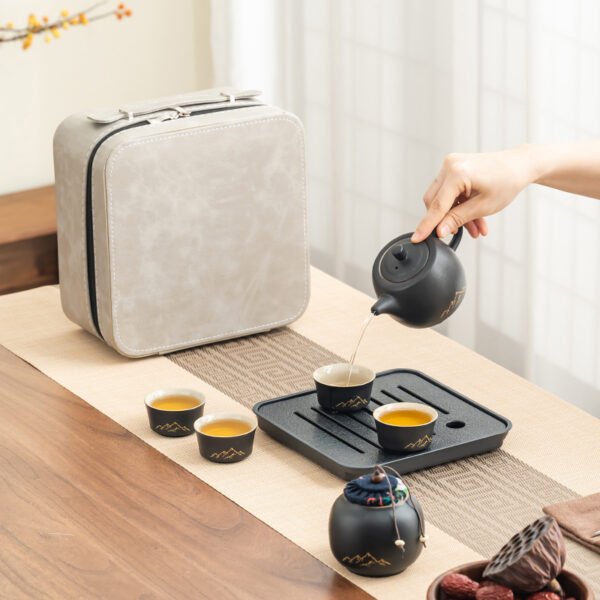
Here, the loop is attached behind the teapot, away from the spout. Look at the opening inside the loop as well as the space between it and the body. A front-facing product image may hide those details.
Request an annotated side view showing the clear height and width inside the handle loop and the overall spout-to-handle length. If finger clearance is a concern, mark the area you want measured on the photograph.
A finger supports the lid in this pictured pour. The selected pot’s instructions determine how to retain its lid and handle it during use.
For packing, check the fitted space around both the projecting handle and the spout. Compare the pot with its intended compartment rather than judging fit from the outside size of the case.
Compare the complete set, not just the handle
Two pots can share a listed capacity while coming with different cup counts and accessories. Likewise, two overhead-handle sets can have different layouts.
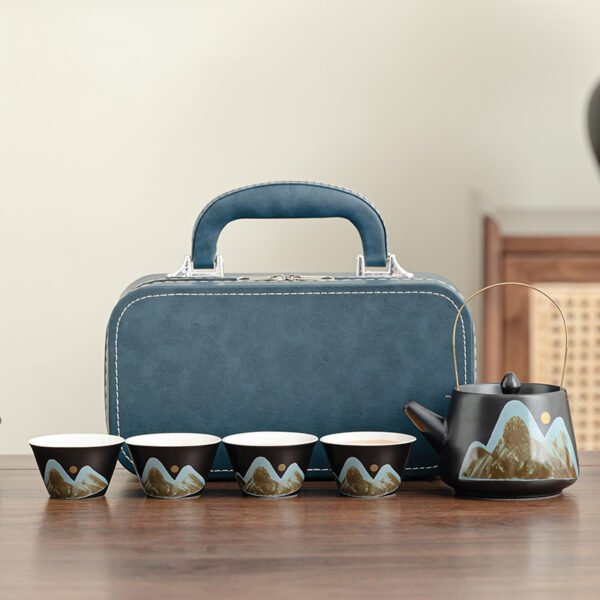
The blue-case example shown here includes one lidded teapot and four cups. The green overhead-handle example includes six cups, a separate pitcher and a strainer arrangement. The rear-handle black set includes four cups, a tea jar and a square tray.
If you want a separate transfer-and-serving stage, check whether a pitcher is included. The fairness pitcher guide explains that role. Handle position does not determine whether a set supplies one.
| Tea set | Teapot handle | Listed pot capacity | Cups supplied |
|---|---|---|---|
| Green set with tray | Wrapped overhead arch | 200 ml | 6 |
| Black mountain-motif set | Rear loop opposite spout | Approx. 200 ml | 4 |
| Mountain-landscape set | Overhead arch | Approx. 230 ml | 4 |
These are separate product configurations, not a controlled comparison of handle performance. Listed capacity is not a measured serving yield. Use your own available tea amount in the tea set capacity calculator when planning pours.
A focused checklist before ordering
- Identify the pot: save the product link and selected finish; distinguish the teapot handle from any pitcher or case handle.
- See the relationship: request views showing the spout, lid knob, handle opening and attachment points.
- Confirm movement: ask whether the handle is fixed or movable and how the lid is accessed.
- Check storage measurements: identify overall height, spout-to-handle length and the intended packed position.
- Match the full configuration: check cup count, pitcher, filter, tray and case against the selected contents list.
- Get the instructions: confirm component-specific use and care information rather than inferring it from the handle shape or wrapping.
The travel tea set buying guide puts these details into the wider selection process. If reviewing a sample for a bulk order, record the exact configuration and any unresolved measurements using the sample review checklist.
Common questions about teapot handles
Which handle is easier to use?
Shortlist by the grip position you want, then compare the actual opening, lid access and packed outline. An overhead arch puts the grip above the lid; a rear loop adds a projection opposite the spout. A sample is the way to assess your own handling preference—neither category is a universal comfort rating.
Does a wrapped handle stay cool?
A photograph of wrapping does not establish its material or temperature during use. Ask for the product’s handling instructions and relevant specifications.
Can I replace an overhead handle with another style?
Match the exact pot, attachment and dimensions before ordering another handle. The replacement-part guide shows how to prepare the photographs and measurements for that enquiry.
Choose a handle within a clearly specified set
Explore the available configurations, then send the product link and the handle, lid-access or packing detail you want to confirm.
Sources and scope: linked product listings and existing photographs, reviewed on 28 October 2026. The comparisons concern visible geometry and listed contents. Handle movement, materials and handling performance have not been tested for this guide; request the selected model’s dimensions and instructions.